|
Crash - Mosquito - type F.II - s/n HJ708 TW°D |

|
|
|
Crash - Mosquito - type F.II - s/n HJ708 TW°D |
|
| Fiche France-Crashes 39-45 modifiée le 12-01-2026 | |||||
| Date | Nation |
 Département Département |
Unité | - | Mission |
|---|---|---|---|---|---|
| 25-03-1944 | Angleterre/Common. | Aisne | 141 Sq RAF | Aulnoye (59): escorte de bombardiers - Transportation Plan | |
| Localisation | 8 km NE Laon (Monceau-le-Waast ?) |
|---|---|
| Circonstances | Probablement problème mécaniques moteur - Avion abandonné en parachute vers 22h45 |
| Commentaires | Décollage 00h55 le 25/3 West Raynham, Norfolk UK |
| Sources ** |
Listes des bombardiers et équipages perdus: Royal Air Force - Bomber Command Losses of the Second World War par WR Listes des bombardiers et équipages perdus: Royal Air Force - Bomber Command Losses of the Second World War par WR Chorley WR Chorley / BomberCommand / rafcommands.com |
| Historique | 01/09/2009=Création - 12/01/2026=Ajout rapport |
| Grade | Prenom | Nom | Poste | Corps | Etat |
Lieu d'Inhumation |
Commentaires |
|---|---|---|---|---|---|---|---|
| F/O | François Emile Désiré | Van Den Plassche | Pil | RAF | Echappé | 132973 - Né le 02/02/1906 Anvers (Belg) - S'enfuit seul par les Pyrénées - Rapport WO 208/3319/1896 | |
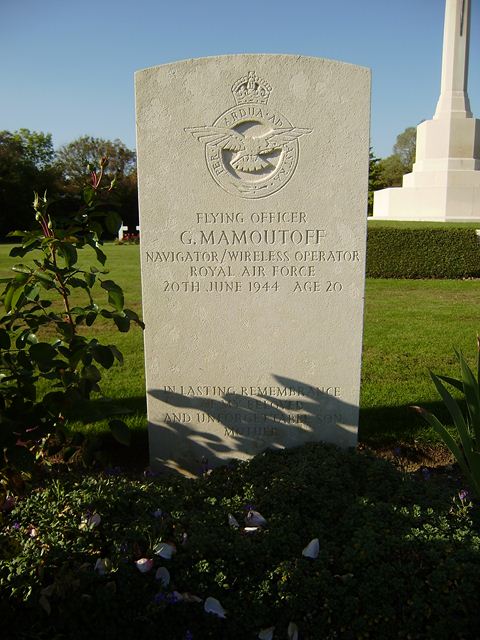
| F/O | George | Mamoutoff | Nav/M | RAF VR | Echappé | 147939 - 20 ans - Fils de Vladimir Mamoutoff, et de Rolly Mamoutoff, de St-Johns Wood, London. - Initialement échappé - Tué le 20/06/1944 au cours de l'attaque par les SS du maquis de St-Mards-en-Othe (10) sous le prénom de Leon - Cim Mil Choloy (54) - Plan - 4.D.8 |
| Fiche tech | Correspondance grades | Abréviations utilisées | Filières d'évasion | Camps de Pow | Bases RAF/USAAF | Utilitaires |
|---|
|
Rapport de perte K.150 - ( Information from : F/O. Van den Plassche F.E.D. Captain & Pilot on 3rd opefrom West Raynham at about 2100 hrs. It was briefed to patrol the Mauberge area for about 20 minutes at a height of 17-18,000 feet. 2. The out ward flight was completed uneventfully and the Mauberge area was reached and patrolled for about 15 minutes without incident. Contact was then established with an enemy aircraft, and this was followed for about 15 minutes. A number of contacts were received but the enemy was never very close and was flying south. The pursuit was therefore abandoned and the Pilot returned towards his allotted area. 3. Approaching Mauberge the Pilot noticed that the oil pressure of the port engine had dropped below 60 lbs. per sq. in. The glycol temperature was steady at 45°. He decided to set course for base immediately. About 5 minutes later he noticed that the oil pressure had dropped to zero and so attempted to feather the engine, but was unable to do so even when he throttled right back. The propeller continued to revolve at a very high speed. 4. A few seconds later he saw that flames and much black smoke were being emitted by the faultly engine. He ordered the Navigator to press the extinguisher button. He repeat the order several times and believed that it was carried out, but it had no effect on the fire. 5. Flames now enveloped the whole engine and had begun to spread back over the wing. The Pilot therefore ordered the Navigator to bale out which he did at once from about 14,000 feet. The Pilot kept the aircraft as straight as possible meanwhile, diving slightly. 6. As soon as the Navigator had gone, the Pilot followed. The cockpit was full of smoke and this obliged him to leave feet first. He was wearing a Pilot-type parachute and he removed his helmet before leaving. He believes that his head just touched the tail-plane as he baled out as he found afterwards that it was badly bruised, but he did not lose consciousness. He made a comfortable descent and landed in the middle of an airfield 3 or 4 miles N.E. of Laon. The Mosquito dived straight down after he left and crashed with violent explosion.Original) - AIR 14/1442/150 - source : Nat Arch UK - Traduction Ph Laroyenne): Renseignements auprès de : F/O. Van den Plassche F.E.D. Capitaine et pilote lors de sa 3ème opération : 1. Le Mosquito a décollé de West Raynham vers 21h00. Il lui a été ordonné de patrouiller dans la région de Maubeuge pendant environ 20 minutes à une altitude de 17 à 18 000 pieds. 2. Le vol aller s'est déroulé sans incident et la zone de Maubeuge a été atteinte et patrouillée pendant environ 15 minutes sans incident. Le contact a ensuite été établi avec un avion ennemi, et il l’a suivi pendant environ 15 minutes. Un certain nombre de contacts ont été reçus mais l'ennemi n'a jamais été très proche et volait vers le sud. La poursuite est donc abandonnée et le pilote revient vers sa zone autorisée. 3. À l'approche de Maubeuge, le pilote a remarqué que la pression d'huile du moteur bâbord était tombée en dessous de 60 lb par pouce carré. La température du glycol était stable à 45°. Il a décidé de mettre immédiatement le cap sur la base. Environ 5 minutes plus tard, il a remarqué que la pression d'huile était tombée à zéro et a donc tenté de mettre le moteur en drapeau, mais n'a pas pu le faire même lorsqu'il a relancé les gaz. L'hélice continuait de tourner à très grande vitesse. 4. Quelques secondes plus tard, il a vu que des flammes et beaucoup de fumée noire étaient émises par le moteur défectueux. Il a ordonné au navigateur d'appuyer sur le bouton de l'extincteur. Il a répété l'ordre plusieurs fois et a cru qu'il avait été exécuté, mais cela n'avait eu aucun effet sur l'incendie. 5. Les flammes enveloppaient maintenant tout le moteur et avaient commencé à se propager sur l'aile. Le pilote a donc ordonné au navigateur de sauter, ce qu'il a fait aussitôt d'environ 14 000 pieds. Pendant ce temps, le pilote a maintenu l'avion aussi droit que possible, en plongeant légèrement. 6. Dès que le navigateur est parti, le pilote a suivi. Le cockpit était enfumé et cela l'a obligé à partir les pieds en premier. Il portait un parachute de type Pilot et il a retiré son casque avant de partir. Il pense que sa tête a juste touché l'empennage alors qu'il sautait en parachute car il a découvert par la suite qu'il était gravement contusionné, mais il n'a pas perdu connaissance. Il a fait une descente confortable et a atterri au milieu d'un aérodrome à 3 ou 4 miles N.E. de Laon. Le Mosquito a plongé directement après son départ et s'est écrasé avec une violente explosion. Rapport F/O Van Den Plassche: - ( On 25 Mar 44 I took off from WEST RAYNHAM at 2100 hrs in a Mosquito night fighter on an offensive patrol near MAUBEUGE (N.W EUROPE, 1:250,000, Sheet 5, O 39). After patrolling in the area of MAUBEUGE for a short time I observed and chased an enemy aircraft in a Southerly direction. This was unsuccessful, and I returned to MAUBEUGE. I noticed the oil pressure was at less than 60 lbs per square inch on the port engine, so decided to return to base. After a few minutes the oil pressure of the port engine dropped to zero. I stopped the engine, but could not feather the airscrew. The engine caught fire and we used the fire extinguishers without success. I told my observer to abandon aircraft at approximately 2245 hrs, and baled out after him. The height was approximately 1400 feet. I saw the aircraft crash in flames. I reached the ground in the centre of a German aerodrome, which was at that time being used for night-flying operations. This aerodrome is situated two or three kilometres West of CHAMBRY (O 0619), and is used by twin-engined aircraft (probably Ju.88's). I packed my mae west, harness, and parachute together, hid them under some bushes, and headed West across the aerodrome, later passing between two woods S.E. of CHAMBRY. I then headed South, until I came to the main road, where I saw a sign-post marked LAON (O 0315) 3 kms. I headed due South to BRUYERE-ET-MONTBERAULT (O 0611), and hid in a hay shed on the outskirts. A farmer discovered me at dawn the following morning (26 Mar). He supplied me with an overcoat and some food, and requested me to leave at once. I removed the detachable tops from my flying boots and started off along the road to VORGES (O 0510). On the outskirts of VORGES I spoke to a woman working in the garden of a house. She obtained trousers, pullover, jacket, shirt, and a cap for me. I remained in her stable until the morning of 27 Mar, when I started off walking towards the West side of the PYRENEES. My route was - BOURG (Sheet 8, T 09) - LONGUEVAL (O 0492) - where a woman directed me to a man at VAUXCERE (O 0290). This man gave me money, food, and shelter for one night. On the morning of 28 Mar I walked to FERE-EN-TARDENOIS (S 9275), where I spent the night at an abandoned farm South of the town. On 29 Mar I walked to MEZY-MOULINS (S 9360), where I took the train (third class) to PARIS. I arrived in PARIS during the afternoon, and took the train (third class) to TOURS, and then to BORDEAUX, where I arrived on the morning of 30 Mar. I then took the train (third class) to TOULOUSE. Because of a control at the Demarcation Line, I had to jump off the train as I had no papers. I walked across the Demarcation Line at LANGON (Sheet 29, O 9555).Original) - ( PARTIE I - WO 208/3319/1896 - Source : Nat Arch UK - Traduction Ph Laroyenne): Le 25 mars 1944, je décolla de West Raynham à 21 h 00 à bord d'un chasseur de nuit Mosquito pour une patrouille offensive près de Maubeuge (N-O Europe, 1/250 000, Feuille 5, ZNG vO3293). Après avoir patrouillé brièvement dans la zone de Maubeuge, j'observai et pris en chasse un avion ennemi en direction du sud. Cette tentative fut infructueuse et je retournai à Maubeuge. Je remarquai que la pression d'huile était inférieure à 4 bars (60 livres par pouce carré) sur le moteur gauche et décidai donc de rentrer à la base. Quelques minutes plus tard, la pression d'huile du moteur gauche chuta à zéro. J'arrêtai le moteur, mais ne parvins pas à mettre l'hélice en drapeau. Le moteur prit feu et nous utilisâmes les extincteurs sans succès. Vers 22 h 45, je demandai à mon observateur d'évacuer l'appareil et sautai en parachute avec lui. L'altitude était d'environ 1 400 pieds [env 425 mètres]. Je vis l'avion s'écraser en flammes. J'ai atterri au centre d'un aérodrome allemand, alors utilisé pour des vols de nuit. Cet aérodrome se situe à deux ou trois kilomètres à l'ouest de Chambry [02] (vO0619) et est utilisé par des avions bimoteurs (probablement des Ju 88). J'ai rassemblé ma Gilet de sauvetage gonflable (du nom de Mary 'Mae' West au buste généreux) Mae West, mon harnais et mon parachute, les ai cachés sous des buissons et me suis dirigé vers l'ouest à travers l'aérodrome, passant ensuite entre deux bois au sud-est de Chambry. J'ai ensuite pris la direction du sud jusqu'à la route principale, où j'ai aperçu un panneau indiquant Laon (vO0315) à 3 km. J'ai continué plein sud jusqu'à Bruyère-et-Montberault (vO0611) et me suis caché dans une grange à foin en périphérie. Un fermier m'a découvert à l'aube le lendemain matin (26 mars). Il m'a donné un manteau et de quoi manger, et m'a demandé de partir immédiatement. J'ai retiré les parties amovibles de mes bottes de vol et me suis mis en route pour Vorges (vO0510). À la sortie de Vorges, j'ai parlé à une femme qui travaillait dans le jardin d'une maison. Elle m'a procuré un pantalon, un pull, une veste, une chemise et une casquette. Je suis resté dans son écurie jusqu'au matin du 27 mars, date à laquelle j'ai entrepris ma marche vers le côté Ouest des Pyrénées. Mon itinéraire était le suivant : Bourg[-et-Comin] (Feuille 8, ZNG vT0496) – Longueval (vT0492) – où une femme m'a indiqué le chemin d'un homme à Vauxcéré (vT0290). Cet homme m'a donné de l'argent, à manger et un abri pour une nuit. Le matin du 28 mars, j'ai marché jusqu'à Fére-en-Tardenois (vS9275), où j'ai passé la nuit dans une ferme abandonnée au sud de la ville. Le 29 mars, j'ai marché jusqu'à Mezy-Moulins (vS9160), où j'ai pris le train (troisième classe) pour Paris. Je suis arrivé à Paris dans l'après-midi et j'ai pris le train (troisième classe) pour Tours, puis pour Bordeaux, où je suis arrivé le matin du 30 mars. J'ai ensuite pris le train (troisième classe) pour Toulouse. Lors d'un contrôle à la ligne de démarcation, j'ai dû descendre du train sans papiers. J'ai franchi la ligne de démarcation à pied à Langon [33] (Feuille 29, FL3 aO9555). Rapport F/O Van Den Plassche: - ( I walked to GIRONDE (aP0858) where I took the train (third class) to TOULOUSE, arriving on the morning of 31 Mar. I remained in TOULOUSE until 1 Apr, when I took the train for BAYONNE, but got off at LAHONCE (S 9939). During the night I walked to VILLAFRANQUE (S 9333) and on 2 Apr to near OLHA (S 8525) - South of GALENTEMA (S 8219), where I crossed the Spanish frontier. I spent the night at a cafe in ZUGURRAMURDI (S 8616). On 3 Apr I went to the Spanish police station at DANCHARINEA (near DANCJARIA) (S 8919), where I was interrogated (name, nationality, date of birth, etc.) and given food. I was sent to URDAX (S 8915), where I stayed in a private house run by the Red Cross until 8 Apr, when I was taken to Irun (S 6524) to the Military Commander. I was again interrogated (name, nationality, date of birth, etc.) and sent to the police station, where I was photographed and had my finger-prints taken. I was sent to an hotel and I telephoned the British Consul at SAN SEBASTIAN, He visited me next day (9 Apr) and brought me clothing, money, cigarettes, etc. I remained in the hotel in IRUN until 19 Apr, when I was taken by an officer of the Spanish Air Force to ALHAMA, where I arrived on 21 Apr and was met by the British Air Attache. On the journey from IRUN to ALHAMA two British and 10 or 12 American airmen joined us. At ALHAMA there was already 10 British airmen. We were conveyed by bus from ALHAMA to MADRID, where we stayed at a hotel until 26 Apr, when we were taken to GIBRALTAR, arriving on 27 Apr. I was not assisted by an organisation during any part of the journey. I did not have any identity papers in my possession. I am a Belgian and I was able to travel easily as I speak fluent French. APPENDIX C - When I was in URDAX (France, 1:250,000, S 8915) I met three members of the French underground movement. They asked me to give their names to C.O.P.A. or Bureau des Operations Aeriennes. Their names are Pierre BARRERE, Guy MARGARITI, and Christian MARGARITI. They were working in Region B. Their chief was M. LEON, who commited suicide when captured by the Gestapo. Indicatif (old) "De Saki a Kaimax". (Latest) "Le meunier a son fils". They request the following message via B.B.C. in French:- "GORTCHAK BRAYLOWSKI et LE RIOU hors de danger, mais en panne en terre e’trangere". (Note: Van Den PLASSCHE was interviewed re above on 3 May 44 by Capt. HEDDY, M.O.1 (S.P.) by arrangement with Capt. HAYWARD.)Original) - ( PARTIE II): J'ai marché jusqu'à Gironde[-sur-Dropt] (aP0858) où j'ai pris le train (troisième classe) pour Toulouse, arrivant le matin du 31 mars. Je suis resté à Toulouse jusqu'au 1er avril, date à laquelle j'ai pris le train pour Bayonne, mais je suis descendu à Lahonce (Feuille 34A, aS9939). Dans la nuit, j'ai marché jusqu'à Villafranque (aS9333) et le 2 avril jusqu'aux environs d'Olha (aS8525), au sud de Galentema (aS8219), où j'ai franchi la frontière espagnole. J'ai passé la nuit dans un café à Zugurramurdi (aS8615). Le 3 avril, je me suis rendu au poste de police espagnol de Dancharinea (près de Dancharia) (aS8917), où j'ai été interrogé (nom, nationalité, date de naissance, etc.) et où l'on m'a donné à manger. J'ai été envoyé à Urdax (aS8915), où j'ai séjourné dans une maison privée gérée par la Croix-Rouge jusqu'au 8 avril, date à laquelle j'ai été conduit à Irun (aS6524) auprès du commandant militaire. J'ai été de nouveau interrogé (nom, nationalité, date de naissance, etc.) et emmené au poste de police, où j'ai été photographié et mes empreintes digitales relevées. J'ai ensuite été conduit à un hôtel et j'ai téléphoné au consul britannique à San Sebastian. Il est venu me voir le lendemain (9 avril) et m'a apporté des vêtements, de l'argent, des cigarettes, etc. Je suis resté à l'hôtel à Irun jusqu'au 19 avril, date à laquelle un officier de l'armée de l'air espagnole m'a emmené à Alhama, où je suis arrivé le 21 avril et où j'ai été accueilli par l'attaché de l'air britannique. Durant le trajet d’Irun à Alhama, deux aviateurs britanniques et une dizaine d'aviateurs américains nous ont rejoints. À Alhama, il y avait déjà dix aviateurs britanniques. Nous avons été transportés en bus d'Alhama à Madrid, où nous avons séjourné dans un hôtel jusqu'au 26 avril, date à laquelle nous avons été conduits à Gibraltar, où nous sommes arrivés le 27 avril. Je n'ai bénéficié d'aucune assistance organisationnelle durant tout le voyage. Je n'étais pas en possession de papiers d'identité. Étant Belge, j'ai pu voyager facilement car je parle couramment français. APPENDIX C - À Urdax (France, 1:250 000, Dossier, FL3 aS8915), j'ai rencontré trois membres de la Résistance française. Ils m'ont demandé de transmettre leurs noms à la COPA ou Bureau des Opérations Aériennes. Il s'agit de Pierre Barrere, Guy Margariti et Christian Margariti. Ils opéraient en Région B. Leur chef était Mr Léon, qui s'est suicidé lors de son arrestation par la Gestapo. Indicatif (ancien) : « De Saki à Kaimax ». (Dernière version) : « Le meunier à son fils ». Ils demandent la diffusion du message suivant par la BBC en français : « GORTCHAK BRAYLOWSKI et LE RIOU hors de danger, mais en panne en terre étrangere ». (NOTE : Van Den Plassche a été interviewé à ce sujet le 3 mai 1944 par le capitaine Heddy, M.O.1 (S.P.), en accord avec le capitaine Hayward.)
|